
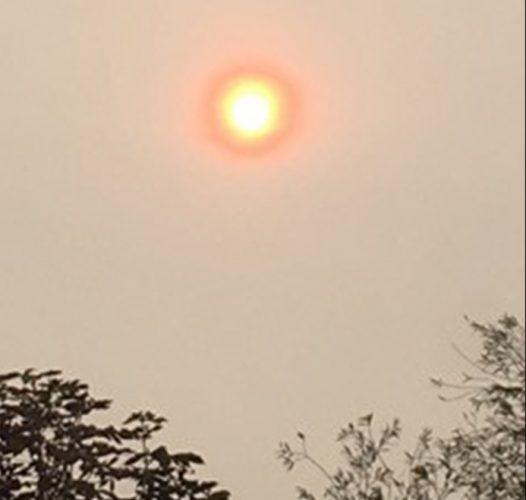
Unprecedented atmospheric event observed in Northern France

On October 17th, sky in Northern France turned yellow. On that day, western and northern regions of France experienced an important atmospheric event characterised by a high concentration of particles. Such conditions have never been observed since the LOA laboratory launched its platform for atmospheric observations in 1992.
A team from LOA laboratory analysed the data collected by several instruments of its measurement platform. Beyond all instruments, the Multi-wavelength Raman LIDAR named LILAS, developped by LOA’s team and supported by the Labex CaPPA, made a significant contribution towards our understanding of the event. It revealed a complex structure of the atmosphere characterised by a mixture of layers composed of desert dusts and biomass burning particles originated from Portugal, reaching an altitude of 8km.

Figure 3
Temporal series of LILAS LiDAR variables (PI. P. Goloub, © Q. Hu, T. Podvin) from 2017/10/16-16:00 to 2017/10/17-06 :00 UTC in Lille (LOA platform) (a) Red areas indicate a high concentration of particles while blue areas indicate a low concentration of particles in the atmosphere. (b) Aerosol depolarization indicates the shape of particles and it consequently informs on their nature, either dust or biomass burning particles here.
This event consequently illustrates how the joint analysis of sun photometers and LIDAR measurements allowed scientists to clearly identify the arrival of different types of aerosols in Lille and to provide time-resolved information on their characteristic features (type, altitude, size, shape).
(content extracted from the press release)
Consult full analysis (only available in french) on the website of the laboratory.
Download the related press release (in french only)
Many internet users and media posted their questioning on social network when observing the sky. #YellowSky or #RedSun #cieljaune
SAGE laboratory contributed to the analysis of the event by interpreting data from its ACSM.

